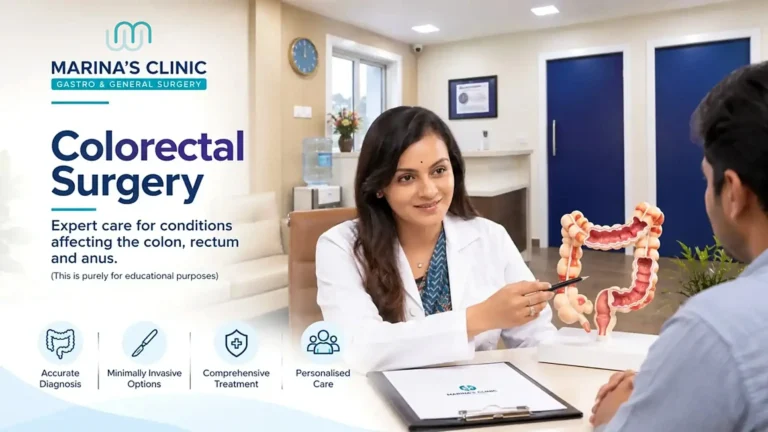
Looking for an experienced colorectal surgeon in Chennai? Dr. Preethi Mrinalini K, MBBS, MS (Gen. Surg.), FMBS, FARIS (RCS Edinburgh), brings more than 12 years of surgical experience to the diagnosis and treatment of colon, rectum, and anal conditions, as Chief Consultant Surgeon at Marina’s Clinic and Consultant Surgeon at Apollo First med Hospitals, Greams Road.
Colon, rectum, and anus are not exactly topics most people feel comfortable talking about. Yet symptoms such as blood in stool, a change in bowel habits, abdominal discomfort, or pain around the anus are things that shouldn’t simply be ignored.
Colorectal surgery in Chennai covers a wide range of conditions affecting the colon, rectum, and anus. Some, such as piles and fissures, are common and usually treatable. Others, including colorectal cancer, need more detailed evaluation and treatment.
The first step is understanding what’s actually causing your symptoms. Once you have a clear doctor, your treatment options become much easier to understand. Finding an experienced colorectal surgeon in Chennai can help you navigate that process with more confidence.
Talk to a surgeon

Colorectal surgery deals with conditions affecting the colon, rectum, and anus. It includes a broad range of colon diseases, rectal diseases, and anal diseases, from relatively common problems to more complex conditions.
A colorectal specialist can assess symptoms, investigate their cause, and recommend the appropriate treatment. Depending on the condition, that may involve lifestyle changes, medication, a minor procedure, or surgery.
If you’re looking for best colorectal surgery the starting point should always be a proper assessment rather than assuming that surgery is automatically required.
Condition | What It Involves |
|---|---|
Colorectal cancer (colon cancer, rectal cancer) | Abnormal cell growth in the colon or rectum that requires appropriate staging and treatment |
Colon polyps | Growths on the colon lining; some types can develop into cancer over time |
Inflammatory bowel disease (IBD) – Crohn’s disease, ulcerative colitis | Long-term inflammation that may require medical treatment and, in some cases, surgery |
Diverticulitis | Inflammation or infection involving small pouches that develop in the colon wall |
Rectal prolapse | A condition where part of the rectum moves down and may protrude through the anus |
Anal fistula | An abnormal tunnel connecting the anal canal with the skin around the anus |
Not every condition listed here needs an operation. Some respond well to medication, dietary changes, or smaller procedures, while others require surgery.
The appropriate treatment depends on what your evaluation shows.
Some bowel symptoms are easy to put down to diet, stress, piles, or a temporary stomach problem. If they persist, though, it’s worth getting them checked by a colorectal specialist in Chennai.
Look out for:
It’s understandable to assume that rectal bleeding is caused by piles, especially if you’ve had piles before. Sometimes it is. But bleeding can have other causes too, including colon polyps and colorectal cancer.
If bleeding is new, persistent, or accompanied by other changes, getting it evaluated is safer than trying to work out the cause yourself.
Colorectal screening is particularly important for detecting colon cancer and rectal cancer early, as they may not cause noticeable symptoms in their early stages.
A colonoscopy allows the doctor to examine the inside of the colon and rectum. If a polyp is found, it can often be removed during the same procedure and sent for further examination.
The appropriate screening schedule depends on factors such as age, symptoms, family history, and individual risk. Your doctor can advise you on when screening is appropriate.
Depending on your symptoms and initial findings, diagnosis may also involve blood tests, CT or MRI imaging, and sometimes a biopsy.
The aim is to understand exactly what’s happening before deciding on treatment.
Not every colorectal problem requires major surgery. Depending on the diagnosis, treatment may involve medication, dietary changes, observation, or a minor procedure.
When surgery is needed, there are different approaches available. The choice depends on the condition, its location and complexity, and your overall health
Approach | What It Involves | General Considerations |
Open surgery | A larger incision provides direct access to the colon or rectum | May be appropriate for certain complex or advanced cases |
Laparoscopic colorectal surgery | Several small incisions are used with camera-guided instruments | Generally associated with less pain and a shorter hospital stay than open surgery |
Robotic colorectal surgery | Robotic-assisted instruments are controlled by the surgeon | An option for selected patients depending on the condition and available expertise |
Laparoscopic colorectal surgery uses small incisions, a camera, and specialised instruments rather than one large abdominal incision.
For suitable patients, minimally invasive colorectal surgery can offer benefits such as less post-operative discomfort and a quicker return to normal activities compared with open surgery.
It may be used for conditions such as diverticulitis and selected colon and rectal cancers, depending on the individual case.
Robotic colorectal surgery is another minimally invasive approach. The surgeon controls robotic-assisted instruments that provide precise movement and a wider range of motion.
It isn’t automatically the right choice for every patient. Whether it offers an advantage depends on the location and complexity of the condition, the planned procedure, and the surgeon’s assessment.
When surgery is required for colorectal cancer, the exact procedure depends on where the tumour is located, its size, and its stage.
Colorectal cancer surgery may involve removing the affected portion of the colon or rectum along with nearby lymph nodes. A colectomy may be performed for certain colon cancers, while the approach for rectal cancer surgery depends on the location of the tumour and the surrounding anatomy.
Treatment may also involve chemotherapy or radiation therapy, depending on the individual diagnosis and cancer stage.
Colon cancer surgery and rectal cancer surgery are not necessarily the same procedure because the anatomy and treatment considerations are different.
The important point is that the surgical plan comes after diagnosis and staging, not before.
Take the Next Step
If you’ve noticed rectal bleeding, a persistent change in bowel habits, blood in stool, ongoing abdominal discomfort, or symptoms around the anus, it’s worth finding out what’s causing them.
You don’t need to assume it’s piles, constipation, or something you’ve eaten. A proper evaluation can identify the cause and help you understand what treatment, if any, is needed.
If you’re looking for colorectal surgery, contact Marina’s Clinic to arrange a consultation and discuss your symptoms with the surgical team.
Hospital stay depends on the type and complexity of colorectal surgery. Minimally invasive procedures may allow earlier discharge, while major or open surgeries may require a longer stay.
Patients are usually advised to begin with small, soft and easy-to-digest meals after colorectal surgery. Fibre and heavier foods can gradually be reintroduced based on bowel function and medical advice
Recovery usually takes several weeks, depending on the type of colorectal surgery performed. Strength, bowel function and normal daily activities generally improve gradually during this period.
Possible risks include infection, bleeding, bowel obstruction, blood clots and leakage from the bowel connection. The individual risk depends on the surgery, underlying condition and overall health.
Not every colorectal surgery requires a stoma. A temporary or permanent colostomy or ileostomy may be needed depending on the location of disease and the type of surgery performed.
Walking is usually encouraged soon after surgery to support recovery. Strenuous exercise and heavy lifting should be resumed gradually after clearance from the surgeon.
The cost varies widely depending on whether surgery is open, laparoscopic or robotic and on the condition being treated. Robotic colorectal surgery may cost roughly ₹2–4 lakh or more.
Follow-up depends on the reason for surgery. Patients may need clinical reviews, colonoscopy, blood tests or scans, particularly after colorectal cancer treatment.
One of Chennai’s best clinics. We provide the most effective treatment for general surgery, gastrointestinal disorders, bariatric and weight loss surgery.
© 2026 Marinas Clinic All rights reserved.Powered by Zero Gravity Technologies.