Many people who notice a small bulge or experience mild discomfort from a hernia often ask the same question
“Can hernias heal without surgery?”
The internet is filled with advice, home remedies, and conflicting opinions that make it difficult to separate fact from fiction.
The Question Everyone Wants Answered: Can Hernias Heal Without Surgery?
Consider having an abnormal mass in your abdomen or groin area. It may not cause much discomfort initially.
Perhaps it occurs while you are coughing, lifting heavy things, or staying standing for extended periods. The immediate conclusion you draw in such situations would probably be whether the condition will resolve itself over time.
Many people avoid consulting a medical specialist, thinking that their body will recover through rest, exercise, change of diet, or natural healing methods. Regrettably, the very nature of this condition explains why such beliefs prove misleading.
Will hernias heal without undergoing surgery? In most cases, the answer is negative. Still, this simple reply barely scratches the surface of a rather intricate issue.
Understanding What a Hernia Really Is
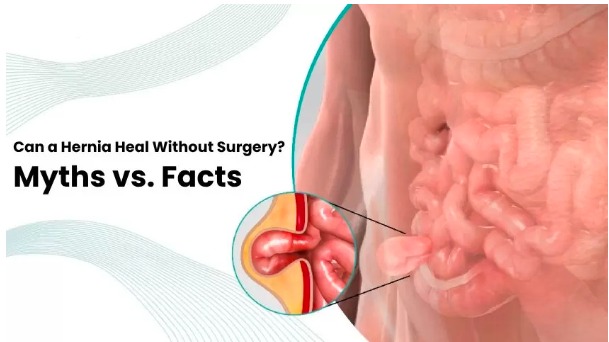
A hernia occurs when an internal organ or tissue pushes through a weakened area of muscle or connective tissue. This creates a visible bulge that may increase in size over time.
Common types of hernias include:
- Inguinal hernias
- Femoral hernias
- Umbilical hernias
- Incisional hernias
- Hiatal hernias
Think of your abdominal wall as a protective barrier. When a weak spot develops, pressure from inside the body can force tissue through that opening. Once this weakness exists, it generally does not repair itself naturally.
This is why medical professionals often recommend proper evaluation and monitoring rather than relying solely on self-care methods.
The Myth of Curing a Hernia Through Exercise
One of the prevalent myths is that targeted exercises will work to strengthen the area where the hernia occurs.
Although exercises are generally good for your health, they will not manage the defect in the muscle tissue. It could be even worse since certain exercises might exert more pressure on the abdomen.
Working out will only make the other surrounding muscles stronger. This will help the patient feel better physically; however, there will still be a defect in the muscle tissue.
The fact is important as many people waste their months by working out and do not notice how their hernia grows.
Debunked: Hernia Belts Are Not a Permanent Cure
Pain does not necessarily indicate the seriousness of the condition.
Hernias are often asymptomatic throughout long periods of time. The lack of any symptoms makes people feel safe and delays medical attention.
Today’s insignificant and asymptomatic hernia can be large tomorrow. With growth, there is an increase in the probability of developing complications.
In some cases, the hernia will become incarcerated, locked, thus unable to return to its usual place. In this situation, there may be a lack of blood supply, and consequently, a medical emergency.
That is why asymptomatic hernias should be examined and observed.
Fact Check: Do Hernia Belts Actually Heal the Condition?
Hernia belts, trusses, and supportive garments are sometimes marketed as alternatives to surgery.
These devices may provide temporary relief by applying pressure to the affected area. Some individuals find them helpful while waiting for treatment or when surgery must be postponed for specific medical reasons.
However, support garments do not repair the muscle defect. Once the device is removed, the hernia remains.
Using a hernia belt should never replace consultation with a healthcare professional who can determine the most appropriate treatment strategy.
Why You Can’t “Wish Away” a Hernia: The Reality of Natural Healing
Unlike cuts, bruises, or minor muscle strains, hernias involve a physical opening or weakness in the body’s supporting structures.
The body has limited ability to repair these defects completely. As daily activities create ongoing pressure within the abdomen, the weakened area often becomes larger rather than smaller.
Factors that can contribute to worsening hernias include:
- Heavy lifting
- Chronic coughing
- Obesity
- Constipation and straining
- Pregnancy
- Aging-related muscle weakness
Because the underlying structural problem remains present, spontaneous healing is extremely uncommon.
When Can a Hernia Be Monitored Instead of Operated On?
All hernias do not need surgery right away.
There are some cases when doctors will advise you to wait and see. This is especially true for patients with small hernias, few symptoms, and no risk of complications, whose health issues prevent surgery.
This means that during this waiting time, you should monitor yourself. The most important thing to know is that waiting does not mean that your hernia is healing on its own.
You are only monitoring your condition until you need surgery.
Warning Signs You Should Never Ignore
One reason hernia awareness is so important is that complications can develop unexpectedly.
Seek medical attention immediately if you experience:
- Sudden severe pain
- Redness around the bulge
- Nausea or vomiting
- Fever
- Difficulty passing stool or gas
- A bulge that cannot be pushed back in
These symptoms may indicate incarceration or strangulation, conditions that can become life-threatening if left untreated.
Prompt evaluation can prevent serious complications and improve outcomes.
How Modern Hernia Surgery Has Changed
Many individuals tend to postpone their treatment due to the assumption that they will spend several days in the hospital and experience excruciating pain during the process of healing.
On the contrary, modern hernia surgeries are quite different from what one can expect.
Thanks to progress made in minimal access and laparoscopic procedures, patients today benefit from less pain, small incisions, accelerated recovery, and a better cosmetic result.
Patients are often surprised how soon they resume their everyday activities after having their hernias treated.
The Importance of Early Diagnosis
One of the biggest mistakes patients make is waiting until symptoms become severe.
Early diagnosis offers several advantages:
- Better treatment planning
- Reduced risk of complications
- More surgical options
- Faster recovery
- Improved outcomes
When a hernia is identified early, healthcare providers can develop a personalized management plan based on the patient’s age, lifestyle, health status, and symptom severity.
This proactive approach often leads to a smoother treatment journey and greater peace of mind.
How Our Healthcare Team Helps Patients Navigate Hernia Treatment
Deciding if one should go through with the surgical operation can be very intimidating because of all the false information floating around.
We help our patients by providing complete evaluations, proper diagnosis, and personalized care for their conditions. We guide our patients from diagnosing what kind of hernia they have down to providing various treatment methods to manage them.
At our health facility, we understand the importance of education about one’s own condition. That’s why we always make sure that all of our patients leave the consultation room feeling enlightened and educated about their condition.
Final Verdict: Can Hernias Heal Without Surgery?
The answer in most cases, is no.
As symptoms may change and some hernias can remain undisturbed for a certain amount of time, one thing is for sure, once diagnosed, a weakness in muscles or tissues will not resolve on its own.
Exercises, compression undergarments, and home remedies can provide comfort, but none of them will address the issue.
At Marinas Clinic, patients receive expert guidance, compassionate care, and evidence-based treatment recommendations designed to help them navigate every stage of their hernia journey.