pregnancy, many women notice that their abdomen does not look or feel the way it did before.
There may be a persistent bulge, a gap in the middle of the abdomen, weakness while exercising, lower-back discomfort, or a small swelling around the belly button.
Two conditions that can cause these changes are diastasis recti and an abdominal hernia.
They may look similar, but they are not the same condition and may need very different treatment.
Marina’s Clinic specifically evaluates both hernia and diastasis recti, including post-pregnancy abdominal bulging and weakness.
What Is Diastasis Recti?
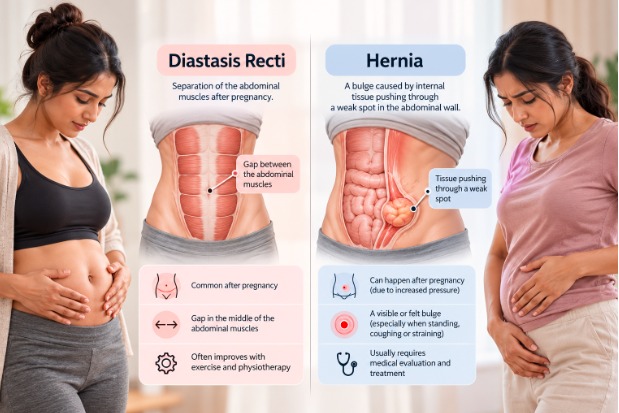
Diastasis recti happens when the two vertical abdominal muscles separate along the connective tissue in the middle of the abdomen.
Pregnancy is one of the most common causes because the growing uterus stretches the abdominal wall.
After delivery, the muscles may gradually move closer together. But in some women, the separation remains for months or even years.
Cleveland Clinic notes that diastasis recti can cause the abdomen to bulge above or below the belly button and may remain after childbirth.
Common signs may include:
- A visible ridge or bulge down the middle of the abdomen
- A persistent “post-pregnancy belly”
- Weakness in the abdominal core
- Difficulty with certain exercises
- Lower-back discomfort
- A feeling that the abdomen lacks support
Diastasis recti itself is not a true hernia, because there is no actual hole or defect through which internal tissue is protruding.
What Is a Hernia?
A hernia develops when tissue pushes through a weak area or defect in the abdominal wall.
After pregnancy, one common location is around the belly button, called an umbilical hernia.
A hernia may appear as a more localized lump or swelling rather than the wider central bulge often seen with diastasis recti.
Symptoms can include:
- A visible or noticeable lump
- Swelling that becomes more obvious while coughing or straining
- A pulling or heavy sensation
- Pain during lifting or exercise
- Discomfort while coughing or sneezing
Marina’s Clinic describes abdominal or groin bulging, heaviness, and discomfort during lifting, coughing, or sneezing among symptoms that should be assessed for a possible hernia.
Diastasis Recti vs Hernia: What Is the Main Difference?
The easiest way to understand the difference is:
Diastasis recti is separation of the abdominal muscles.
A hernia is a defect or opening in the abdominal wall.
With diastasis recti, the connective tissue between the muscles becomes stretched and thinner.
With a hernia, fat, intestine, or another tissue may push through a weakened area.
A person can also have both conditions at the same time.
That is why relying only on how the abdomen looks can sometimes be misleading.
Why Pregnancy Can Lead to Both Conditions
Pregnancy naturally places increasing pressure on the abdominal wall.
Hormonal changes also allow connective tissues to stretch as the body prepares for childbirth.
Factors that may increase abdominal-wall strain include:
- Multiple pregnancies
- Twin or multiple pregnancy
- A larger baby
- Significant abdominal stretching
- Previous abdominal surgery
- Increased body weight
Diastasis recti is relatively common after pregnancy. NHS guidance notes that separation of the abdominal muscles commonly occurs during pregnancy and often begins improving after childbirth.
However, when the gap or bulge persists, causes discomfort, or affects daily activity, it may be worth getting evaluated.
Can Diastasis Recti Improve Without Surgery?
Many cases can improve with appropriate rehabilitation.
Treatment may include exercises designed to strengthen the deeper abdominal muscles and improve core control.
But not every exercise is suitable.
Exercises that create excessive outward abdominal pressure may sometimes make the bulging more noticeable.
Working with a physiotherapist or healthcare professional experienced in postpartum abdominal rehabilitation can therefore be helpful.
Surgery is generally not automatically required simply because diastasis recti is present.
The decision depends on factors such as severity, symptoms, functional problems, associated hernia, and the individual’s goals.
Does a Hernia Heal on Its Own?
A true abdominal hernia generally does not close on its own.
That does not mean every hernia needs immediate surgery, but it does mean the defect itself should be properly assessed.
Marina’s Clinic advises evaluation for persistent abdominal bulging, heaviness, or pain rather than simply waiting for symptoms to disappear.
Treatment decisions usually depend on:
- Hernia size
- Symptoms
- Location
- Whether the swelling is increasing
- Impact on daily activities
- Risk of complications
- Whether diastasis recti is also present
For appropriate patients, minimally invasive approaches may be considered.
When Should You See a Surgeon?
Consider getting evaluated if you notice:
- A persistent bulge months after pregnancy
- A lump around the belly button
- Pain while lifting, coughing, or exercising
- Increasing abdominal swelling
- Core weakness affecting everyday activities
- A bulge that does not improve with rehabilitation
- Difficulty determining whether the problem is fat, muscle separation, or a hernia
A clinical examination can often provide important clues.
In some cases, imaging may be advised to confirm the diagnosis or assess the abdominal wall more closely.
When Is It an Emergency?
Seek urgent medical attention if a hernia becomes suddenly very painful, firm, or difficult to push back in, especially if this is accompanied by vomiting, abdominal swelling, or feeling unwell.
These symptoms can occasionally indicate that tissue has become trapped and needs urgent treatment.
Don’t Assume Every Post-Pregnancy Bulge Is Weight Gain
One of the most common mistakes is assuming that a persistent abdominal bulge is simply stubborn postpartum fat.
Sometimes it may be.
But it could also be diastasis recti, a hernia, or both.
And each condition is managed differently.
At Marina’s Clinic, post-pregnancy abdominal bulging, hernia, and diastasis recti can be assessed to determine what is actually causing the problem and whether rehabilitation, observation, or surgical treatment is appropriate.
The first step is not deciding whether you need surgery.
It is getting the diagnosis right