
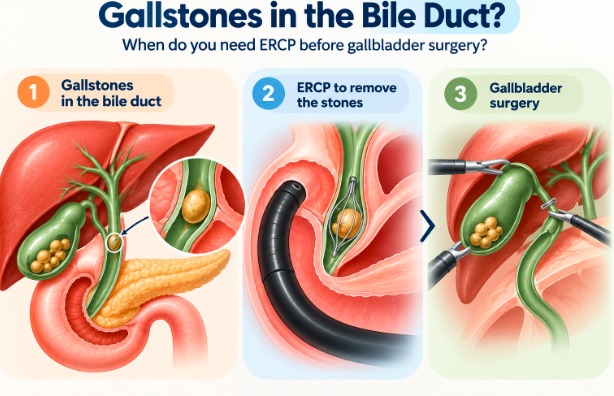
Gallstones usually form inside the gallbladder.
But sometimes, a stone can leave the gallbladder and travel into the common bile duct — the small tube that carries bile from the liver and gallbladder to the intestine.
When this happens, the condition is called choledocholithiasis, or common bile duct stones.
This is different from having stones only inside the gallbladder because a stone blocking the bile duct can lead to jaundice, infection, or pancreatitis.
In some patients, the bile duct may need to be cleared with a procedure called ERCP before gallbladder surgery is performed.
Marina’s Clinic also lists ERCP as a procedure used to identify and manage gallstones lodged in the bile duct.
Why Are Bile Duct Stones More Concerning?
The gallbladder stores bile produced by the liver.
When you eat, bile travels through the bile ducts into the small intestine to help with digestion.
If a gallstone moves into the common bile duct and becomes stuck, bile may not be able to drain normally.
This blockage can cause symptoms such as:
- Severe upper abdominal pain
- Pain on the right side below the ribs
- Nausea or vomiting
- Yellowing of the eyes or skin
- Dark urine
- Pale stools
- Fever or chills
Gallstones blocking the bile duct can also cause inflammation of the pancreas or infection of the bile ducts.
How Do Doctors Know if a Stone Has Entered the Bile Duct?
Your surgeon will usually look at several things together.
Blood Tests
Blood tests may show increased bilirubin or changes in liver enzymes.
These findings can suggest that bile flow is being blocked.
Ultrasound
An ultrasound may show gallstones, enlargement of the bile duct, or occasionally a stone inside the duct.
MRCP
MRCP, or magnetic resonance cholangiopancreatography, is a special MRI scan used to examine the bile ducts.
It is non-invasive and can help determine whether a bile duct stone is actually present.
For patients with an intermediate likelihood of common bile duct stones, guidelines recommend tests such as MRCP or endoscopic ultrasound before proceeding to ERCP.
This is important because ERCP is generally used when there is a reasonable likelihood that treatment will actually be needed.
What Exactly Is ERCP?
ERCP stands for:
Endoscopic Retrograde Cholangiopancreatography.
During the procedure, a flexible endoscope is passed through the mouth, stomach, and into the first part of the small intestine.
The doctor then accesses the opening of the bile duct.
Contrast dye and X-rays may be used to identify the blockage.
If a stone is found, the doctor may enlarge the bile duct opening with a small cut called a sphincterotomy and remove the stone using a balloon or basket.
So ERCP is not simply a scan.
It can diagnose and treat the blockage during the same procedure.
When Is ERCP Usually Needed?
ERCP may be considered when there is strong evidence that a stone is trapped in the common bile duct.
This can include situations such as:
- A bile duct stone seen on imaging
- Obstructive jaundice
- Significant bile duct enlargement along with abnormal blood tests
- Infection of the bile ducts, known as cholangitis
Professional guidance identifies confirmed stones on imaging or ascending cholangitis among the situations where ERCP may be appropriate without additional diagnostic testing first.
Does Everyone With Gallstones Need ERCP?
No.
If stones are only inside the gallbladder and there is no evidence of bile duct blockage, ERCP is usually unnecessary.
In uncomplicated symptomatic gallstone disease, treatment may simply involve laparoscopic cholecystectomy, where the gallbladder is removed through small incisions.
ERCP is mainly useful when stones have entered the bile duct.
This distinction matters because ERCP itself carries risks.
Possible complications include:
- Pancreatitis
- Bleeding
- Infection
- Perforation
The overall risk varies depending on the patient and the procedure being performed, which is one reason doctors avoid using ERCP purely as a routine diagnostic test when less-invasive imaging can answer the question first.
Why Is Gallbladder Surgery Still Needed After ERCP?
This is one of the most common patient questions.
If ERCP removes the stone, why remove the gallbladder?
Because ERCP clears the bile duct, but it usually does not remove the gallbladder where the stones originally formed.
If the gallbladder remains, more stones may potentially move into the bile duct later.
For patients with suitable health and symptomatic gallstone disease, definitive treatment often involves laparoscopic gallbladder removal after the duct has been cleared.
NICE guidance recommends clearing common bile duct stones either during laparoscopic surgery or with ERCP before or around the time of gallbladder surgery.
Which Comes First: ERCP or Gallbladder Surgery?
There is no single sequence for every patient.
In some cases:
ERCP → bile duct stone removal → laparoscopic gallbladder surgery
may be recommended.
In other situations, bile duct stones can be treated during the surgical admission depending on available expertise and the patient’s condition.
Clinical guidelines allow bile duct treatment before, during, or sometimes after gallbladder surgery depending on the circumstances.
Your surgeon and gastroenterology team will decide based on:
- Scan findings
- Blood results
- Symptoms
- Presence of infection
- Pancreatitis
- Overall health
When Is It an Emergency?
Seek urgent medical attention if gallstone symptoms are accompanied by:
- Yellow eyes or skin
- Fever or chills
- Severe persistent abdominal pain
- Repeated vomiting
- Confusion or feeling severely unwell
A blocked and infected bile duct can become serious and may require urgent drainage and treatment.
Gallbladder Stones and Bile Duct Stones Are Not the Same Problem
Finding gallstones does not automatically mean you need ERCP.
But when a stone moves into the common bile duct, the treatment plan changes.
At Marina’s Clinic, assessment may include blood tests, imaging, and surgical evaluation to determine whether the problem is limited to the gallbladder or whether the bile duct is also involved.
The important question is not simply:
“Do I have gallstones?”
It is:
“Where are the stones, and are they blocking the normal flow of bile?”
Getting that answer helps determine whether you need gallbladder surgery alone or bile duct treatment such as ERCP first