
Scrotal swelling can be uncomfortable, worrying, and sometimes embarrassing to talk about.
One possible cause is a hydrocele — a collection of fluid around the testicle that causes the scrotum to enlarge.
Hydroceles are more common in babies, but adults can develop them too, often after inflammation, infection, or injury in the scrotal area. A hydrocele is usually not dangerous, but any new scrotal swelling should be examined because other conditions, including hernia or testicular problems, can look similar.
What Is a Hydrocele?
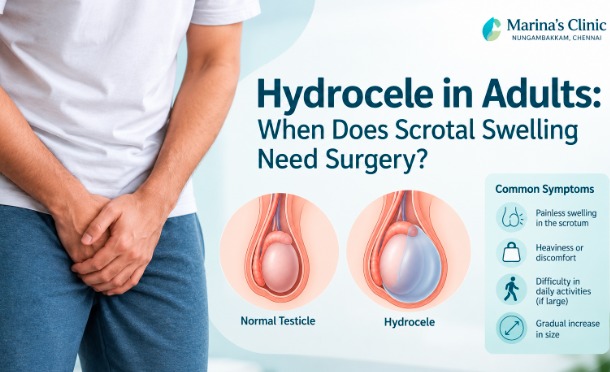
A hydrocele develops when fluid collects in the thin sac surrounding a testicle.
It may affect one side or both sides of the scrotum.
The most common sign is painless swelling.
Some men may also notice:
- A feeling of heaviness
- Mild discomfort
- Increasing swelling during the day
- Difficulty with walking or physical activity if the hydrocele becomes large
Mayo Clinic notes that pain may increase as the swelling becomes larger, although many hydroceles remain painless.
What Causes a Hydrocele in Adults?
Unlike childhood hydroceles, adult hydroceles may develop after another problem affects the scrotum.
Possible causes include:
- Injury to the scrotum
- Inflammation
- Infection around the testicle
- Previous surgery
- In some cases, no obvious cause
Mayo Clinic notes that inflammation from infection of the testicle or surrounding structures can contribute to hydrocele formation in adults.
This is one reason why adult-onset scrotal swelling should not simply be ignored.
Hydrocele or Hernia: How Can You Tell?
A hydrocele and an inguinal hernia can both produce swelling around the groin or scrotum.
But they are different conditions.
A hydrocele contains fluid around the testicle.
An inguinal hernia occurs when abdominal tissue pushes through a weak area in the groin.
A hernia may become more noticeable when:
- Standing
- Coughing
- Straining
- Lifting something heavy
It may also reduce when lying down.
A hydrocele often feels smoother and more fluid-filled.
However, appearance alone cannot reliably distinguish the two.
During an examination, a doctor may check how the swelling changes with pressure or coughing and may shine a light through the scrotum. Ultrasound can also help identify a hydrocele and rule out hernia or other causes of swelling.
Does Every Hydrocele Need Surgery?
No.
A hydrocele does not automatically require an operation.
If it is small, painless, and not causing functional problems, your doctor may recommend observation.
Some hydroceles can remain stable without causing major symptoms.
However, treatment may be considered when the swelling becomes persistent or increasingly troublesome.
Cleveland Clinic notes that surgery may be recommended when a hydrocele does not resolve on its own or begins causing problems.
When Should Surgery Be Considered?
Hydrocele surgery may be considered when:
- The swelling becomes large
- There is persistent discomfort or heaviness
- Walking or physical activity becomes difficult
- The swelling interferes with daily life
- The diagnosis remains uncertain
- The hydrocele continues to increase in size
- There is an associated hernia
The procedure used to treat a hydrocele is called a hydrocelectomy.
During surgery, the surgeon removes or repairs the sac containing the fluid.
The exact approach depends on the size and type of hydrocele as well as the patient’s overall health.
Can Medicine Shrink a Hydrocele?
There is no medication that reliably makes an established hydrocele disappear.
Pain relief may help with temporary discomfort, but it does not remove the fluid collection itself.
Cleveland Clinic states that if a persistent hydrocele requires definitive correction, surgery is the standard treatment.
This is why repeated self-treatment without getting the swelling examined may delay the correct diagnosis.
Is Hydrocele Surgery Major Surgery?
Hydrocelectomy is generally considered a relatively straightforward surgical procedure.
Cleveland Clinic notes that the operation often takes less than an hour, although the exact duration and recovery depend on the individual case.
Possible risks can include:
- Swelling
- Bruising
- Infection
- Bleeding
- Recurrence of the hydrocele
Your surgeon should discuss these risks and the expected recovery before the procedure.
How Long Does Recovery Take?
Many people can resume light daily activities within several days, although strenuous work, exercise, and heavy lifting may need to be avoided for longer.
Cleveland Clinic notes that full recovery can take a few weeks, depending on the individual and the type of work they do.
Your doctor may recommend:
- Wearing supportive underwear
- Keeping the surgical area clean
- Avoiding heavy lifting
- Using prescribed pain medicines
- Returning for follow-up as advised
Swelling and bruising after surgery can be expected for a period of time.
When Should Scrotal Swelling Be Checked Urgently?
Any sudden or severe scrotal pain should be assessed urgently.
Do not assume that every swelling is a hydrocele.
Seek prompt medical attention if the swelling is associated with:
- Sudden severe pain
- Fever
- Redness
- Rapidly increasing swelling
- Nausea or vomiting
- A hard or unusual testicular lump
A hydrocele is usually benign, but other conditions causing scrotal pain or swelling may require urgent treatment.
Mayo Clinic specifically advises people with scrotal swelling to seek medical evaluation so that other causes can be ruled out.
Don’t Ignore Persistent Scrotal Swelling
A hydrocele may be painless and harmless, but that does not mean every scrotal swelling should be left unchecked.
The first step is confirming what is actually causing it.
At Marina’s Clinic, hydroceles are among the minor surgical conditions evaluated and treated, alongside hernia and other general surgical problems.
If the swelling is small and comfortable, observation may be enough.
If it keeps growing, becomes uncomfortable, or interferes with everyday life, surgery may be considered.
The decision should be based on your symptoms, examination, and diagnosis — not simply the size of the swelling.