Introduction
Have you noticed a small bulge around your abdomen, belly button, or groin that becomes more visible when you cough, lift something heavy, or stand for a long time? It could be a hernia.
A hernia develops when an internal organ or tissue pushes through a weak area in the surrounding muscle or connective tissue. Some hernias cause mild discomfort, while others may lead to pain and complications if left untreated.
One of the first questions patients ask after a hernia diagnosis is, “Can a hernia be treated without surgery?”
The answer depends on the type of hernia, its size, symptoms, and risk of complications. While certain approaches can help manage symptoms, most hernias do not heal permanently without surgical repair.
At Marina’s Clinic, we believe that understanding your treatment options helps you make informed decisions about your health.
In this blog, let’s explore which non-surgical hernia treatments may help, what they cannot do, and when surgery becomes important.
What Is a Hernia?
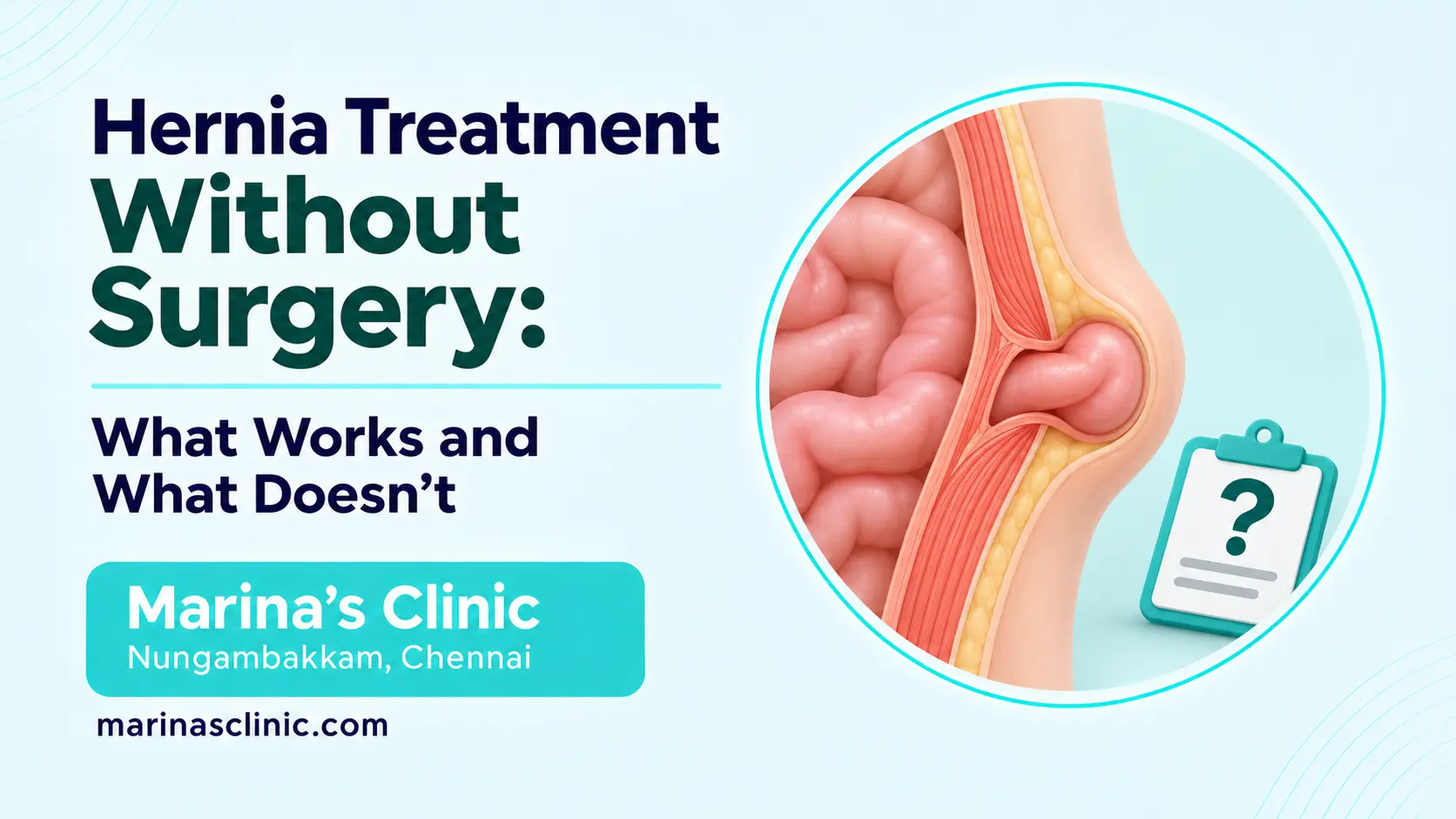
A hernia occurs when tissue, such as part of the intestine or fatty tissue, pushes through a weak spot in the abdominal wall or surrounding muscle.
It may appear as a visible lump or bulge that becomes more noticeable during activities that increase pressure inside the abdomen.
Common types of hernia include:
- Inguinal hernia: Develops in the groin area and is more common in men.
- Umbilical hernia: Appears near the belly button.
- Incisional hernia: Develops through or near a previous surgical incision.
- Femoral hernia: Occurs in the upper thigh or groin area.
- Hiatal hernia: Happens when part of the stomach moves through the diaphragm into the chest cavity.
The symptoms and treatment approach depend on the type and severity of the hernia.
Can a Hernia Be Treated Without Surgery?
Yes, some hernias can be managed without immediate surgery, but this does not mean the hernia is permanently cured.
For example, a doctor may recommend watchful waiting for certain small, minimally symptomatic inguinal hernias in men. In other cases, lifestyle changes and symptom management may help reduce discomfort.
However, a hernia is caused by a weakness or opening in the surrounding tissue. Medicines, exercises, and home remedies cannot reliably close that opening.
Surgery is generally the only definitive way to repair most abdominal wall hernias.
What Works for Hernia Treatment Without Surgery?
Although non-surgical approaches cannot usually repair the hernia itself, some measures may help manage symptoms and reduce unnecessary strain.
1. Watchful Waiting Under Medical Supervision
Is surgery always necessary immediately after a hernia diagnosis?
Not necessarily. For selected patients with a small inguinal hernia that causes little or no discomfort, a doctor may recommend watchful waiting.
This means monitoring the hernia regularly instead of proceeding with immediate surgery.
During this period:
- Attend recommended medical follow-up appointments.
- Monitor changes in the size of the bulge.
- Report increasing pain or discomfort.
- Avoid activities that cause significant symptoms.
- Understand the warning signs that require urgent care.
Watchful waiting is not suitable for every type of hernia or every patient. It should only be considered after a medical assessment.
2. Maintaining a Healthy Body Weight
Excess body weight can increase pressure inside the abdomen, potentially worsening hernia symptoms.
If you are overweight, gradual and sustainable weight management may help reduce pressure on the abdominal wall.
Helpful habits include:
- Eating a balanced diet.
- Practising regular, doctor-approved physical activity.
- Avoiding crash diets.
- Managing weight under appropriate medical guidance.
Weight management may improve overall health and surgical readiness, but it does not close the hernia.
3. Preventing Constipation
Straining during bowel movements can increase pressure inside the abdomen and make hernia discomfort worse.
To help prevent constipation:
- Include fibre-rich foods such as vegetables, fruits, and whole grains.
- Drink adequate water.
- Stay physically active as advised.
- Avoid delaying bowel movements.
- Discuss persistent constipation with your doctor.
If constipation continues, medical advice can help identify the cause and suitable treatment.
4. Managing Chronic Cough
Frequent coughing can repeatedly increase pressure inside the abdomen.
If you have a persistent cough, consult a doctor to identify and treat its underlying cause.
Managing conditions such as respiratory infections, asthma, or allergies may help reduce repeated strain.
Avoid ignoring a cough that lasts for several weeks or is accompanied by other concerning symptoms.
5. Avoiding Heavy Lifting and Excessive Strain
Heavy lifting and activities that cause discomfort may aggravate certain hernias.
Consider the following precautions:
- Avoid lifting objects that cause pain or pulling sensations.
- Use proper lifting techniques when appropriate.
- Avoid holding your breath while lifting.
- Discuss exercise restrictions with your doctor.
- Do not push through pain during physical activity.
You do not necessarily need to stop all physical activity. Your doctor can guide you on what is safe for your particular condition.
6. Using a Hernia Belt or Support Garment
Some patients ask whether wearing a hernia belt can avoid surgery.
A hernia belt or truss is a supportive garment designed to hold a hernia bulge in place temporarily.
In selected situations, a doctor may recommend one for symptom support, particularly when surgery is not immediately possible.
However, remember:
- A hernia belt does not repair the weakened muscle.
- It does not permanently remove the hernia.
- Incorrect use may cause discomfort or skin irritation.
- It should be fitted and used under medical guidance.
- It must not delay treatment if warning symptoms develop.
A hernia belt should never be considered a permanent cure.
What Does NOT Work for Hernia Treatment?
Many people search online for home remedies or exercises that promise to cure a hernia naturally.
It is important to distinguish between methods that may help manage symptoms and treatments that actually repair the hernia.
Here are some common misconceptions.
1. Medicines Cannot Close the Hernia
Can tablets or painkillers cure a hernia?
No. Medicines may help manage associated symptoms, such as pain, constipation, or acid reflux in selected patients, but they cannot close the opening in the abdominal wall.
Pain relief should not be used to ignore worsening symptoms.
2. Home Remedies Cannot Repair the Muscle Weakness
Applying oils, using herbal preparations, or trying traditional home remedies cannot reliably repair the weakened tissue responsible for a hernia.
Some remedies may temporarily make a person feel more comfortable, but they do not provide a definitive cure.
3. Exercises Cannot Push the Hernia Back Permanently
Certain exercises may strengthen surrounding muscles and support general fitness, but they cannot reliably close the defect through which the hernia develops.
Exercises involving heavy abdominal strain may actually worsen discomfort in some patients.
Always discuss suitable physical activities with your doctor.
4. Weight Loss Alone Cannot Cure a Hernia
Losing excess weight may reduce pressure inside the abdomen and improve overall health.
However, even after successful weight loss, the existing hernia opening generally remains.
Weight management should be viewed as supportive care rather than a replacement for hernia repair when surgery is indicated.
When Is Hernia Surgery Necessary?
Although some hernias can be monitored, surgery may be recommended when symptoms become troublesome or there is a risk of complications.
Your doctor may discuss surgical repair if you experience:
- Increasing pain or discomfort.
- A hernia that is growing in size.
- Difficulty performing everyday activities.
- Repeated episodes of the hernia becoming difficult to push back.
- A hernia that is associated with bowel obstruction.
- A higher risk of complications based on its type and clinical findings.
The decision depends on your health, hernia type, symptoms, and individual risk factors.
What Are the Warning Signs of a Complicated Hernia?
A hernia can sometimes become trapped or strangulated.
An incarcerated hernia occurs when the protruding tissue becomes trapped and cannot return to its normal position.
A strangulated hernia occurs when the blood supply to the trapped tissue is compromised. This is a medical emergency.
Seek emergency medical attention if you experience:
- Sudden or severe pain around the hernia.
- A bulge that becomes firm, tender, or cannot be pushed back.
- Red, purple, or dark discolouration over the bulge.
- Nausea and vomiting.
- Abdominal swelling.
- Inability to pass stools or gas.
- Fever along with abdominal pain.
Do not attempt to force a painful or trapped hernia back into place. Do not wait for symptoms to settle on their own.
What Are the Surgical Treatment Options for Hernia?
When surgery is recommended, the surgeon may discuss different techniques depending on the hernia type and your medical condition.
1. Open Hernia Repair
Open hernia repair involves making an incision near the hernia to return the protruding tissue to its proper position and repair the weakened area.
A surgical mesh may be used to strengthen the repair, depending on the patient’s condition and the surgeon’s assessment.
2. Laparoscopic Hernia Repair
Laparoscopic hernia repair is a minimally invasive procedure performed through small incisions using a camera and specialised instruments.
Potential benefits for suitable patients include:
- Smaller surgical incisions.
- Less wound discomfort in some cases.
- Earlier return to routine activities for many patients.
- The possibility of treating hernias on both sides through the same approach.
However, laparoscopic surgery is not suitable for every patient. The choice depends on the hernia, previous surgeries, overall health, and surgical expertise.
3. Robotic Hernia Repair
Robotic-assisted hernia repair uses specialised robotic instruments controlled by the surgeon.
It may be appropriate for selected complex cases, depending on the available facilities and the surgeon’s experience.
Not every patient needs robotic surgery. Your surgeon can explain whether it offers a meaningful advantage in your situation.
How Do Doctors Decide Whether You Need Hernia Surgery?
The treatment recommendation is based on a detailed medical assessment.
Your doctor may consider:
- Type and location of the hernia.
- Size of the hernia.
- Whether it causes pain or discomfort.
- Whether the bulge can return to its normal position.
- Risk of bowel obstruction or strangulation.
- Your age and general health.
- Previous abdominal operations.
- Your daily activities and lifestyle.
A physical examination is often the first step. Depending on the findings, an ultrasound or CT scan may be recommended.
The aim is to identify the safest and most appropriate treatment for your condition.
Frequently Asked Questions About Hernia Treatment Without Surgery
1. Can a hernia go away without surgery?
Most adult abdominal wall hernias do not disappear permanently without surgical repair. Some small, minimally symptomatic hernias may be monitored under medical supervision, but the underlying weakness generally remains.
2. Can I live with a hernia without surgery?
Some people can live with certain hernias for a period without immediate surgery. However, this depends on the type of hernia, symptoms, and risk of complications. Regular medical assessment is important.
3. Can a hernia be cured with exercise?
No. Exercise cannot reliably close the opening in the abdominal wall. Appropriate physical activity may support general health, but exercises that strain the abdomen can worsen symptoms.
4. Does wearing a hernia belt cure a hernia?
No. A hernia belt may provide temporary support in selected cases, but it does not repair the weakened tissue or permanently cure the hernia.
5. Can medicines treat a hernia?
Medicines cannot repair the hernia itself. They may help manage related symptoms, such as pain or constipation, but the underlying defect remains.
6. Is hernia surgery always necessary?
Not always immediately. Certain minimally symptomatic inguinal hernias in men may be managed with watchful waiting. However, many hernias eventually require surgery, particularly when symptoms develop or complications occur.
7. Is laparoscopic hernia surgery better than open surgery?
Both techniques have advantages and limitations. Laparoscopic repair may offer smaller incisions and faster recovery for suitable patients, while open repair may be more appropriate in other situations. The surgeon will recommend the suitable approach.
8. Can lifting heavy weights cause a hernia?
Heavy lifting can increase pressure inside the abdomen and may contribute to a hernia developing or make an existing hernia more noticeable. However, hernias usually involve an underlying weakness in the abdominal wall.
9. How do I know if my hernia is becoming serious?
Increasing pain, a growing or firm bulge, difficulty pushing the bulge back, nausea, vomiting, or abdominal swelling may indicate a complication. Sudden severe pain or a painful trapped bulge requires emergency medical attention.
10. When should I consult a surgeon for a hernia?
Consult a qualified surgeon if you notice a new bulge around your abdomen or groin, experience recurring discomfort, or have been diagnosed with a hernia. Seek emergency care immediately if you develop signs of strangulation or bowel obstruction.
Conclusion
Hernia treatment without surgery may be possible in selected situations, particularly when symptoms are mild and a doctor recommends careful monitoring. Lifestyle changes, weight management, preventing constipation, and avoiding excessive strain can help manage discomfort and support overall health.
However, it is important to understand that these measures do not permanently repair the weakened area responsible for the hernia. Medicines, exercises, home remedies, and hernia belts cannot reliably replace surgical repair when it is medically necessary.
At Marina’s Clinic, we believe that the right treatment begins with an accurate diagnosis and proper medical guidance. If you notice a hernia or experience recurring discomfort, consult a qualified surgeon to understand your options and determine whether monitoring or surgery is appropriate.
Don’t ignore a persistent bulge or abdominal discomfort. Early medical advice can help you make the right decision for your health.
Quick Summary
- A hernia develops when tissue pushes through a weak area in the surrounding muscle or abdominal wall.
- Some minimally symptomatic hernias may be monitored under medical supervision.
- Weight management, preventing constipation, and managing chronic cough may help reduce abdominal strain.
- Hernia belts may provide temporary support but do not cure the condition.
- Medicines, home remedies, and exercises cannot permanently close the hernia.
- Surgery is generally the definitive treatment for most abdominal wall hernias.
- Open, laparoscopic, and robotic-assisted techniques may be considered depending on the patient’s condition.
- Sudden severe pain, a painful trapped bulge, vomiting, or abdominal swelling requires emergency medical attention.