From symptoms to treatment, here is a complete guide to understanding incisional hernia and when a surgical evaluation may be needed. An incisional hernia is a bulge that develops through a weakened area of the abdominal wall at the site of a previous surgery. It can appear months or even years after an operation and may become more noticeable when you stand, cough, lift something, or strain.
If you notice a new swelling around an old surgical scar, it is worth getting it checked. An early evaluation can help determine the size of the hernia, whether it is causing complications, and whether treatment is necessary.
What Exactly Is an Incisional Hernia?
An incisional hernia develops when the abdominal wall does not regain enough strength after surgery. The weakened area can allow fat, tissue, or part of the intestine to push through, creating a bulge along or near the previous surgical incision.
It is different from a hernia that develops through a naturally weak area of the abdominal wall because the weakness here is related to a previous surgical closure. The European Hernia Society describes an incisional hernia as a defect occurring at the site of a previous abdominal wall incision.
An incisional hernia may not be obvious immediately after surgery. Some develop months later, while others become noticeable several years after the original operation.
What Are the Symptoms of an Incisional Hernia?
The most common sign is a bulge around a previous surgical scar.
You may notice that:
- The swelling becomes more prominent when standing
- It appears or increases when coughing or straining
- It becomes smaller when lying down
- There is a pulling or aching sensation around the scar
- The abdomen feels heavy or weak around the affected area
- Pain becomes more noticeable with lifting or physical activity
Some incisional hernias may cause very few symptoms in the beginning. The bulge may simply become larger over time. Others can cause discomfort, bloating, difficulty with bowel movements, or nausea if bowel becomes involved.
A persistent or growing swelling around an old surgical scar should be evaluated rather than assumed to be normal post-surgical tissue.
When Is an Incisional Hernia an Emergency?
Most incisional hernias can be evaluated and treated electively. However, complications can occur when the contents of the hernia become trapped.
Seek immediate medical attention if you experience:
- Sudden or severe pain at the hernia site
- A bulge that becomes hard, tender, or cannot be pushed back
- Red, purple, or dark skin over the swelling
- Fever or chills
- Nausea or vomiting
- Difficulty passing stool or gas
These symptoms can indicate incarceration, bowel obstruction, or strangulation, where the blood supply to trapped tissue is compromised. Such situations require urgent medical assessment.
Why Do Incisional Hernias Occur?
An incisional hernia can result from a combination of factors related to the original surgery, healing process, and the patient’s overall health.
Patient-Related Risk Factors
Some factors can increase the likelihood of developing an incisional hernia:
Obesity: Higher abdominal pressure can put additional stress on the healing abdominal wall.
Smoking: Smoking affects blood flow and can interfere with normal wound healing.
Diabetes: Poorly controlled blood sugar can delay tissue healing.
Poor nutrition: Adequate protein and nutrients are important for wound repair.
Chronic cough: Repeated coughing increases pressure inside the abdomen.
Chronic constipation: Frequent straining during bowel movements can place additional stress on the abdominal wall.
Age, previous wound infection, multiple abdominal surgeries, long-term steroid use, and conditions such as ascites can also increase the risk.
The type and location of the original incision also matter. Midline abdominal incisions are associated with a higher risk of incisional hernia than some other incision types.
Does an Incisional Hernia Require Surgery?
An incisional hernia in an adult generally does not heal on its own because the underlying abdominal-wall defect does not spontaneously close.
However, surgery is not necessarily an emergency for every patient.
A small hernia that causes no symptoms may sometimes be monitored, particularly when surgery carries significant risks because of other medical conditions. On the other hand, an enlarging or painful hernia may be better treated with planned surgery.
Your surgeon will consider the size and location of the defect, symptoms, previous surgeries, overall health, weight, and risk of complications before recommending treatment.
How Is an Incisional Hernia Repaired?
The main surgical approaches are open repair and minimally invasive repair, which can include laparoscopic or robotic techniques.
Open Incisional Hernia Repair
During open surgery, an incision is made over or near the hernia. The protruding tissue is returned to the abdomen, and the weakened abdominal wall is repaired.
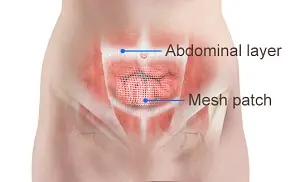
Mesh is commonly used to reinforce the repair because evidence shows that mesh can substantially reduce the risk of recurrence compared with suture-only repair.
Open repair may be appropriate for larger or complex hernias, particularly when a patient has undergone multiple previous abdominal operations or when extensive scar tissue is expected.
Laparoscopic or Robotic Incisional Hernia Repair
Minimally invasive repair uses several small incisions through which a camera and surgical instruments are introduced.
The surgeon places mesh to reinforce the weakened area. Compared with open surgery, minimally invasive approaches may offer smaller incisions, less wound-related morbidity in selected patients, and a faster return to normal activities. However, the best approach depends on the individual hernia and the surgeon’s assessment.
Previous abdominal surgery, adhesions, hernia size and location, obesity, and overall health all need to be considered before choosing the technique.
Is Mesh Safe for Incisional Hernia Repair?
Mesh has become an important part of modern incisional hernia repair because it provides additional reinforcement to the abdominal wall.
Research has consistently shown that mesh repair reduces recurrence compared with suture-only repair. A meta-analysis of randomised trials involving ventral and incisional hernias found a significant reduction in recurrence with mesh repair.
However, mesh is not completely free of risks. Complications can include infection, seroma, chronic pain, or other mesh-related problems. Long-term research also shows that these complications need to be balanced against the lower recurrence risk offered by mesh.
The type of mesh and its position are therefore chosen based on the size, location, complexity, and contamination risk of the hernia rather than using the same approach for every patient.
How Long Does Incisional Hernia Surgery Take?
There is no single operating time for every incisional hernia.
A small and straightforward repair may take around 30 to 60 minutes, while larger or more complex hernias can require considerably longer. Previous operations, adhesions, the surgical approach, the size of the defect, and whether additional procedures are required can all affect the operating time.
Hospital stay also varies. Simple repairs may be suitable for same-day discharge, while larger or complex repairs may require an overnight or longer stay.
How Can You Reduce the Risk of an Incisional Hernia?
Not every incisional hernia can be prevented, but addressing modifiable risk factors can help.
Before planned abdominal surgery, maintaining a healthy weight, controlling diabetes, stopping smoking, improving nutrition, and managing chronic cough or constipation can support better healing.
After surgery, following your surgeon’s instructions about lifting, wound care, activity, and constipation is equally important. A gradual return to normal activity is preferable to rushing back to heavy exercise or lifting.
Incisional Hernia Recovery After Surgery
Recovery depends on the size of the hernia and the type of repair performed.
During the first few weeks, light walking is generally encouraged while strenuous activity and heavy lifting are restricted. Activity can then be increased gradually as healing progresses.
For many patients, returning to normal activities takes several weeks, while larger or complex repairs may require a longer recovery period. Your surgeon will give you specific instructions based on your repair and overall health.
Frequently Asked Questions
Can an incisional hernia heal itself?
No. An incisional hernia does not normally close on its own in adults because the abdominal-wall defect remains. Surgery is the definitive way to repair the defect when treatment is required.
Is mesh safe for incisional hernia repair?
Mesh is widely used and can significantly reduce the risk of recurrence. Like any surgical material, it has potential complications, so your surgeon should discuss the benefits and risks for your specific case.
Does incisional hernia require surgery?
Not every small, symptom-free hernia needs immediate surgery. However, an incisional hernia will not normally heal by itself, and treatment may be recommended if it becomes painful, enlarges, or develops complications.
Can an incisional hernia come back after surgery?
Yes. Hernia repair reduces the defect but does not make recurrence impossible. Factors such as obesity, smoking, wound infection, and the complexity of the original hernia can influence recurrence risk. Mesh repair generally has a lower recurrence risk than suture-only repair.
Is laser surgery used for incisional hernia?
No. Incisional hernias are repaired using surgical techniques such as open, laparoscopic, or robotic repair. Mesh and sutures may be used depending on the repair. “Laser surgery” is not a standard treatment for an incisional hernia.
When Should You See a Hernia Surgeon?
If you develop a new lump or swelling around a previous abdominal surgery scar, especially if it is increasing in size or becoming painful, arrange a surgical evaluation.
Early assessment allows the surgeon to determine whether the swelling is an incisional hernia and whether observation or repair is appropriate. For a personalised evaluation, consult Dr. Preethi Mrinalini K for expert guidance on your treatment options.
If the swelling becomes suddenly painful, firm, irreducible, or is accompanied by vomiting, fever, or difficulty passing stool or gas, seek urgent medical care