
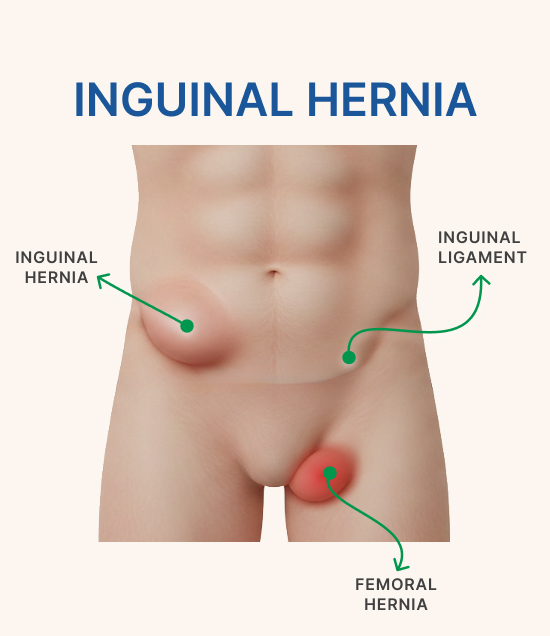
Everything You Need to Know About Inguinal Hernia starts with understanding what it is. An inguinal hernia occurs when tissue, such as part of the intestine or abdominal lining, pushes through a weakened area in the groin. The most common sign is a bulge that becomes more noticeable when you stand, cough, or strain.
Inguinal hernias are the most common type of abdominal wall hernia, accounting for around 75% of abdominal wall hernias. Treatment depends on your symptoms, the type of hernia, and your overall health.
If you’re looking for the best hernia surgeon, Dr. Preethi Mrinalini K at Marina’s Clinic provides general and laparoscopic surgical care, with a focus on personalised treatment and minimally invasive approaches where appropriate.
Understanding Inguinal Hernias
What Happens in an Inguinal Hernia?
Your abdominal wall normally keeps the organs and tissues inside your abdomen in place. When a weak area develops in the groin, tissue can push through that opening and form a visible or palpable bulge.
The tissue involved may be part of the intestine, fatty tissue, or the lining of the abdominal cavity. The bulge can become more obvious when pressure inside your abdomen increases, such as when coughing, lifting, or straining.
Why Do Inguinal Hernias Occur?
There isn’t always one single reason. Some people have a weakness in the groin from birth, while others develop one gradually as the abdominal wall becomes weaker.
Factors that can contribute include:
- Increasing age
- Chronic coughing
- Constipation and repeated straining
- Heavy lifting
- Obesity
- Smoking
- Pregnancy
- Previous abdominal surgery
In men, the anatomy of the groin also makes inguinal hernias particularly common.
Types of Inguinal Hernias
Direct vs Indirect Inguinal Hernias
There are two main types of inguinal hernia:
Indirect inguinal hernia develops through the internal inguinal ring and follows the pathway associated with the spermatic cord. It is often related to a weakness that has been present since birth.
Direct inguinal hernia pushes through a weakened area of the abdominal wall in the groin. It is more commonly associated with weakening of the abdominal wall over time.
The distinction is mainly anatomical, and your surgeon can determine the type during a physical examination or, when necessary, with imaging.
Recognizing the Signs: Symptoms of Inguinal Hernia
The most noticeable sign is often a groin bulge. You may see or feel it when standing, coughing, sneezing, lifting, or straining.
The bulge may become smaller or disappear when you lie down, particularly during the early stages of a reducible hernia.
Other symptoms can include:
- Groin pain or discomfort
- A heavy or dragging sensation
- Burning or aching around the groin
- Discomfort while bending or lifting
- A swelling that extends towards the scrotum in men
Some inguinal hernias cause very little discomfort, while others gradually become more noticeable and interfere with everyday activities.
Symptoms in Men vs Women
In men, an inguinal hernia can extend towards the scrotum and cause swelling or discomfort in that area.
Women can also develop groin hernias, although they are less common. Because groin symptoms in women can have other causes, a proper examination is particularly important.
When Symptoms Signal an Emergency
A hernia needs urgent medical attention if the bulge suddenly becomes very painful, firm, tender, or cannot be pushed back in or no longer reduces when lying down.
Pain accompanied by nausea, vomiting, abdominal bloating, constipation, or fever can indicate a complication such as bowel obstruction or strangulation.
How to Detect an Inguinal Hernia
Self-Check at Home
You may notice an inguinal hernia yourself by standing in front of a mirror and looking for a groin bulge.
Coughing or gently straining can make the swelling more visible. You may also notice that it becomes smaller when you lie down.
However, a self-check cannot confirm the diagnosis. A groin lump can have several causes, so seeing a doctor is the safest way to establish what you’re dealing with.
Clinical Diagnosis: What Doctors Do
For most people with typical symptoms, a physical examination is enough to diagnose an inguinal hernia.
Your doctor may examine the groin while you’re standing and ask you to cough or strain. Both sides may also be examined because hernias can occur on either side.
When Is Imaging Needed?
Imaging isn’t always necessary. If the examination is unclear, an ultrasound may help identify an occult or less obvious hernia.
CT or MRI may be considered in more complicated cases, recurrent hernias, or when another condition needs to be ruled out.
Can Inguinal Hernia Be Treated Without Surgery?
Non-Surgical Management Options
Not every inguinal hernia needs immediate surgery. For some men with an asymptomatic or minimally symptomatic hernia, watchful waiting can be an option after discussing the benefits and risks with a doctor.
During this period, managing constipation, maintaining a healthy weight, treating a chronic cough, and avoiding activities that clearly aggravate your symptoms can help.
These measures may make you more comfortable, but they don’t repair the underlying weakness in the abdominal wall.
Can It Heal or Resolve on Its Own?
In adults, an established inguinal hernia generally does not close on its own.
Watchful waiting can be appropriate for selected patients, but it means monitoring the hernia rather than expecting the defect to disappear. If symptoms increase or complications develop, surgical repair may become necessary.
Treatment Options: How to Fix an Inguinal Hernia
Surgical Repair
When an inguinal hernia is causing symptoms, surgery is generally the definitive treatment.
There are two broad approaches: open hernia repair and laparoscopic or keyhole repair. Mesh is commonly used to reinforce the weakened area, although the appropriate technique depends on the individual patient and hernia.
Open Hernia Repair
Open repair involves an incision in the groin through which the surgeon returns the herniated tissue to its proper position and reinforces the weakened area.
It remains an established treatment and can be appropriate depending on the hernia, patient factors, and surgeon’s expertise.
Laparoscopic Hernia Repair
Laparoscopic repair uses several small incisions and a camera to access and repair the hernia.
It can be particularly useful in selected patients, including some people with bilateral or recurrent hernias. The choice between open and laparoscopic repair should be based on the patient’s condition, the hernia characteristics, and available surgical expertise.
What to Expect From Surgery
Inguinal hernia repair is commonly performed as a day-care or short-stay procedure, although this depends on the patient’s health and the type of operation.
The NHS notes that the procedure itself commonly takes around 30 to 90 minutes, with recovery generally taking around 4 to 6 weeks. Light activity and walking are usually encouraged during recovery, while heavy lifting and strenuous activity are restricted initially.
The exact timeline should come from your surgeon rather than a fixed number because recovery varies between patients.
Potential Complications if Left Untreated
Can Inguinal Hernia Cause Back Pain?
Back pain isn’t considered a typical symptom of an inguinal hernia.
However, ongoing groin discomfort may change the way someone walks, stands, or moves, which can contribute to discomfort elsewhere. Persistent back pain should therefore be evaluated separately rather than automatically attributed to the hernia.
Can Inguinal Hernia Cause Infertility?
Infertility isn’t a usual consequence of an uncomplicated inguinal hernia.
Very large or complicated hernias can affect structures within the groin, while surgery itself carries uncommon risks to surrounding structures. If fertility is a concern, discuss it with your surgeon before treatment.
Can Inguinal Hernia Cause Weight Loss?
Weight loss isn’t a typical symptom of an uncomplicated inguinal hernia.
Unexplained weight loss, particularly when accompanied by persistent abdominal symptoms, vomiting, or changes in bowel habits, should be evaluated rather than assumed to be caused by the hernia.
Prevention and Risk Reduction
You can’t prevent every inguinal hernia, particularly those related to an underlying anatomical weakness.
However, maintaining a healthy weight, staying physically active, treating chronic cough, managing constipation, avoiding smoking, and using sensible lifting techniques may reduce some contributing factors.
Do’s
- Maintain a healthy weight
- Treat chronic cough
- Keep constipation under control
- Use proper lifting technique
- Stay physically active
Don’ts
- Don’t ignore a growing groin bulge
- Don’t repeatedly strain during bowel movements
- Don’t smoke
- Don’t continue an activity that consistently causes hernia pain
- Don’t delay evaluation if symptoms are changing
Internal linking: For a detailed guide on what to do and avoid during recovery, read our Do’s and Don’ts After Inguinal Hernia Surgery guide.
When to See a Doctor
See a doctor if you notice a new groin lump, swelling, or persistent groin discomfort.
You should seek urgent medical attention if the bulge becomes suddenly painful, hard, tender, or cannot be reduced, especially if you also have nausea, vomiting, abdominal swelling, constipation, or fever.
At Marina’s Clinic, Dr. Preethi Mrinalini K provides general and laparoscopic surgical care. The clinic states that she has more than 12 years of experience, has completed training in Minimal Access Surgery, and currently works as a Consultant Surgeon at Apollo Main Hospitals as well as at Marina’s Clinic.
Frequently Asked Questions
What does an inguinal hernia look like?
It often appears as a soft bulge or lump in the groin that becomes more noticeable when standing, coughing, or straining. It may become smaller when you lie down.
How common are inguinal hernias?
Inguinal hernias account for around 75% of abdominal wall hernias. Lifetime risk has been estimated at about 27% in men and 3% in women.
Can children get inguinal hernias?
Yes. In children, inguinal hernias are usually related to an opening that has not closed properly during development. They require assessment by a doctor because they do not simply disappear in most cases.
Will a hernia come back after surgery?
A hernia can recur after repair, although recurrence is not inevitable. The risk depends on factors including the type of repair, the hernia itself, patient factors, and surgical technique.
Final Takeaway
An inguinal hernia is common, but a groin bulge should not simply be ignored. Some small, minimally symptomatic hernias can be monitored, while symptomatic hernias are generally considered for surgical repair.
The important part is getting the diagnosis right and understanding which treatment actually suits your situation. If you’re searching for the best hernia surgeon in Chennai, you can consult Dr. Preethi Mrinalini K for an evaluation and personalised guidance on whether monitoring, open repair, or laparoscopic treatment is appropriate for you.