
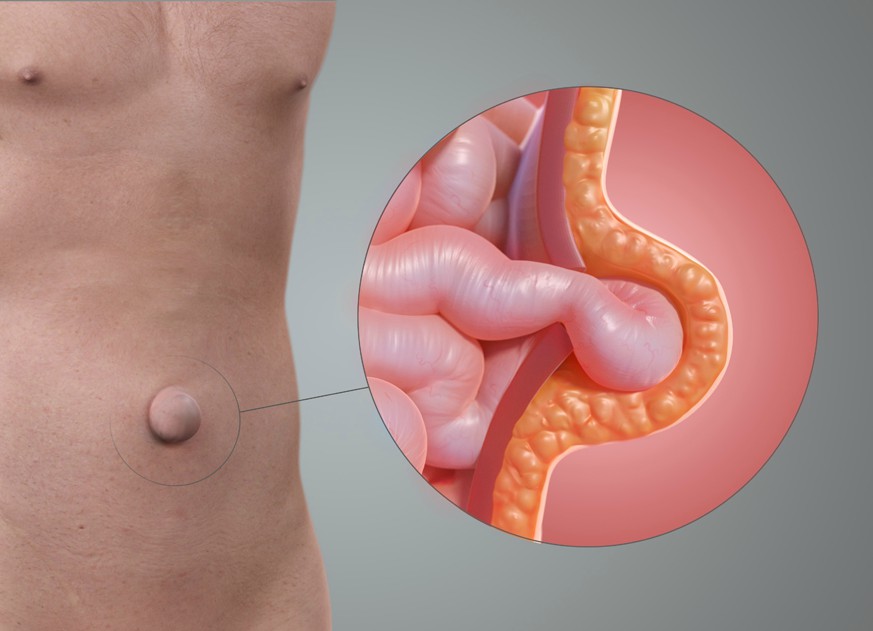
Here is a complete guide to understanding inguinal hernia and knowing when it needs medical attention. An inguinal hernia occurs when tissue, such as part of the intestine or abdominal lining, pushes through a weakened area in the groin.
Understanding What Happens in an Umbilical Hernia
The Anatomy Behind It
The belly button, or umbilicus, is the site where the umbilical cord passed through the abdominal wall before birth. After birth, this opening normally closes as the abdominal wall develops.
If the area remains weak or becomes weakened later in life, tissue such as fat or part of the intestine can push through it. This creates the characteristic bulge at or around the navel.
What Does an Umbilical Hernia Look and Feel Like?
An umbilical hernia often looks like a soft, round swelling at the belly button.
You may notice that it becomes more prominent when you stand, cough, lift something, or strain, and becomes smaller when you lie down. Some adults also describe a dull ache, pressure, or discomfort around the area.
Not every umbilical hernia is painful. In fact, some are noticed simply because of the visible change around the belly button.
Why Do Umbilical Hernias Occur?
In Infants and Children
In babies, an umbilical hernia usually develops because the opening through which the umbilical cord passed has not completely closed.
This is common in newborns and young children, and many childhood umbilical hernias close naturally as the abdominal wall becomes stronger. Cleveland Clinic notes that they usually disappear by around age 5.
Most children therefore don’t need immediate surgery unless the hernia is causing problems or shows signs of complications.
In Adults
Adult umbilical hernias are different. They can develop when weakness in the abdominal wall combines with increased pressure inside the abdomen.
Factors associated with adult umbilical hernias include:
- Obesity
- Pregnancy and multiple pregnancies
- Chronic coughing
- Constipation and repeated straining
- Ascites or fluid accumulation in the abdomen
- Previous abdominal surgery
- Increasing age
Having one of these risk factors doesn’t mean you will definitely develop a hernia. It simply increases the likelihood.
Is Umbilical Hernia Dangerous?
When It’s Not an Emergency
A small umbilical hernia that is soft, reducible, and causing little or no discomfort may not require emergency treatment.
However, adults should still have a new umbilical hernia assessed by a doctor. The decision to monitor or repair it depends on symptoms, hernia characteristics, overall health, and the risk of future complications.
Warning Signs of Complications
An umbilical hernia can occasionally become incarcerated, meaning the tissue becomes trapped and cannot be pushed back into the abdomen.
If the blood supply to that trapped tissue becomes compromised, it can become strangulated, which is a medical emergency.
Seek urgent medical attention if the hernia suddenly becomes:
- Very painful or increasingly painful
- Firm or hard
- Difficult or impossible to push back
- Red, purple, or unusually dark
Nausea, vomiting, abdominal swelling, fever, or difficulty passing stool or gas alongside these symptoms are also warning signs that need prompt medical assessment.
Can Umbilical Hernia Be Treated Without Surgery?
For Infants and Young Children
Yes. Watchful waiting is commonly used for uncomplicated umbilical hernias in children because many close naturally as the child grows.
Surgery may be considered if the hernia persists, becomes symptomatic, or develops complications. The exact timing should be decided by a paediatric surgeon based on the child’s age and the hernia itself.
For Adults
An adult umbilical hernia does not normally close by itself.
Weight management, treating constipation or chronic cough, and avoiding activities that aggravate symptoms may help reduce pressure on the abdominal wall, but these measures don’t repair the actual defect.
For symptomatic adult umbilical hernias, surgical repair is the definitive treatment. Current European and American Hernia Society guidelines recommend mesh repair for most symptomatic umbilical and epigastric hernias because mesh reduces the risk of recurrence.
Which Surgery Is Best for Umbilical Hernia?
There isn’t one operation that is automatically best for everyone. The choice depends on the size and location of the defect, your previous surgeries, BMI, general health, and risk of wound complications.
Open Repair
Open repair is performed through an incision close to the belly button. The herniated tissue is returned to the abdomen and the abdominal-wall defect is repaired.
For many symptomatic umbilical hernias, guidelines recommend an open repair using a flat mesh placed in the preperitoneal space.
Open surgery can be suitable for many small and moderate hernias and may be performed as a relatively short procedure.
Laparoscopic Repair
Laparoscopic repair uses small incisions, a camera, and specialised instruments to repair the hernia from inside the abdomen.
A laparoscopic approach may be considered when the defect is large or when the patient has a higher risk of wound complications. It isn’t automatically better than open repair for every patient.
The important question isn’t simply “open or laparoscopic?” It is which approach provides the safest and most appropriate repair for your particular hernia.
The Role of Mesh in Umbilical Hernia Repair
Mesh is used to reinforce the weakened abdominal wall and reduce the chance of recurrence.
The decision to use mesh depends on factors including the size of the hernia, previous surgery, and your overall health. Your surgeon should explain where the mesh will be placed and why it is appropriate for your case.
Current guidelines support mesh for most symptomatic umbilical hernias, although the exact technique should be individualised.
Making the Decision: Which Approach Is Right for You?
Your surgeon will usually consider:
- Hernia size and location
- Whether it is painful or symptomatic
- Whether it can be reduced
- Your BMI and overall health
- Previous abdominal surgery
- Risk of wound complications
- Whether this is a first or recurrent repair
- The surgeon’s experience with the available techniques
For example, a small uncomplicated hernia may be suitable for an open repair, while a larger defect or a patient with a higher risk of wound complications may be considered for a laparoscopic approach.
The technique should therefore be chosen around you and your hernia, rather than treating every umbilical hernia in exactly the same way.
What to Expect After Surgery
Recovery Timeline
Umbilical hernia repair is commonly performed under general anaesthesia and may be completed as a day-case procedure depending on the patient and operation.
The NHS states that surgery usually takes around 30 to 60 minutes, while full recovery can take approximately 4 to 6 weeks. People with physically demanding jobs may need longer away from heavy lifting.
Post-Operative Care(internal link to dos and dont blog page)
After surgery, your surgeon will give you specific instructions about:
- Keeping the incision clean and protected
- Taking prescribed pain medication
- Gradually increasing activity
- Avoiding heavy lifting until cleared
- Preventing constipation and straining
- Attending follow-up appointments
Mild soreness and swelling can occur during recovery, but increasing pain, fever, wound discharge, or significant swelling should be reported to your medical team.
Prevention and Risk Reduction
Not every umbilical hernia can be prevented, particularly when the weakness is related to anatomy or previous surgery.
You can, however, reduce some contributing factors by:
- Maintaining a healthy weight
- Managing constipation
- Treating a persistent cough
- Staying physically active
- Using sensible lifting techniques
- Avoiding smoking
- Managing medical conditions that increase abdominal pressure
If you already have an umbilical hernia, these measures may help reduce strain, but they won’t close the existing defect.
Frequently Asked Questions
Can an umbilical hernia heal itself?
In children, many uncomplicated umbilical hernias close naturally as the abdominal wall develops. In adults, an established umbilical hernia generally does not close on its own and may require surgical repair if symptomatic.
What is the reason for umbilical hernia?
In babies, it usually results from incomplete closure of the umbilical ring after birth. In adults, abdominal-wall weakness combined with increased abdominal pressure can contribute to its development.
How serious is an umbilical hernia?
Many umbilical hernias are not immediately dangerous, particularly when they are small and reducible. However, a hernia can become incarcerated or strangulated, so sudden pain, a firm non-reducible bulge, vomiting, or discoloration needs urgent assessment.
Will the hernia come back after surgery?
A hernia can recur after repair, although mesh reinforcement generally lowers recurrence compared with suture repair alone. Your individual risk depends on the hernia, repair technique, health factors, and healing.
How long does surgery take?
An umbilical hernia repair usually takes around 30 to 60 minutes, although the exact duration varies with the complexity of the repair and the surgical technique used.
Final Takeaway
An umbilical hernia is essentially a weakness around the belly button that allows tissue from inside the abdomen to push outward. In children, many cases resolve naturally, while symptomatic adult hernias are commonly treated surgically.
The right repair depends on the size of the defect, your health, previous surgeries, and the risk of complications. For personalised evaluation and treatment planning, consult Dr. Preethi Mrinalini K, who can assess your hernia and recommend the most appropriate approach.